Current Research
As If Random:
How an Autocrat Times his Public Abscence
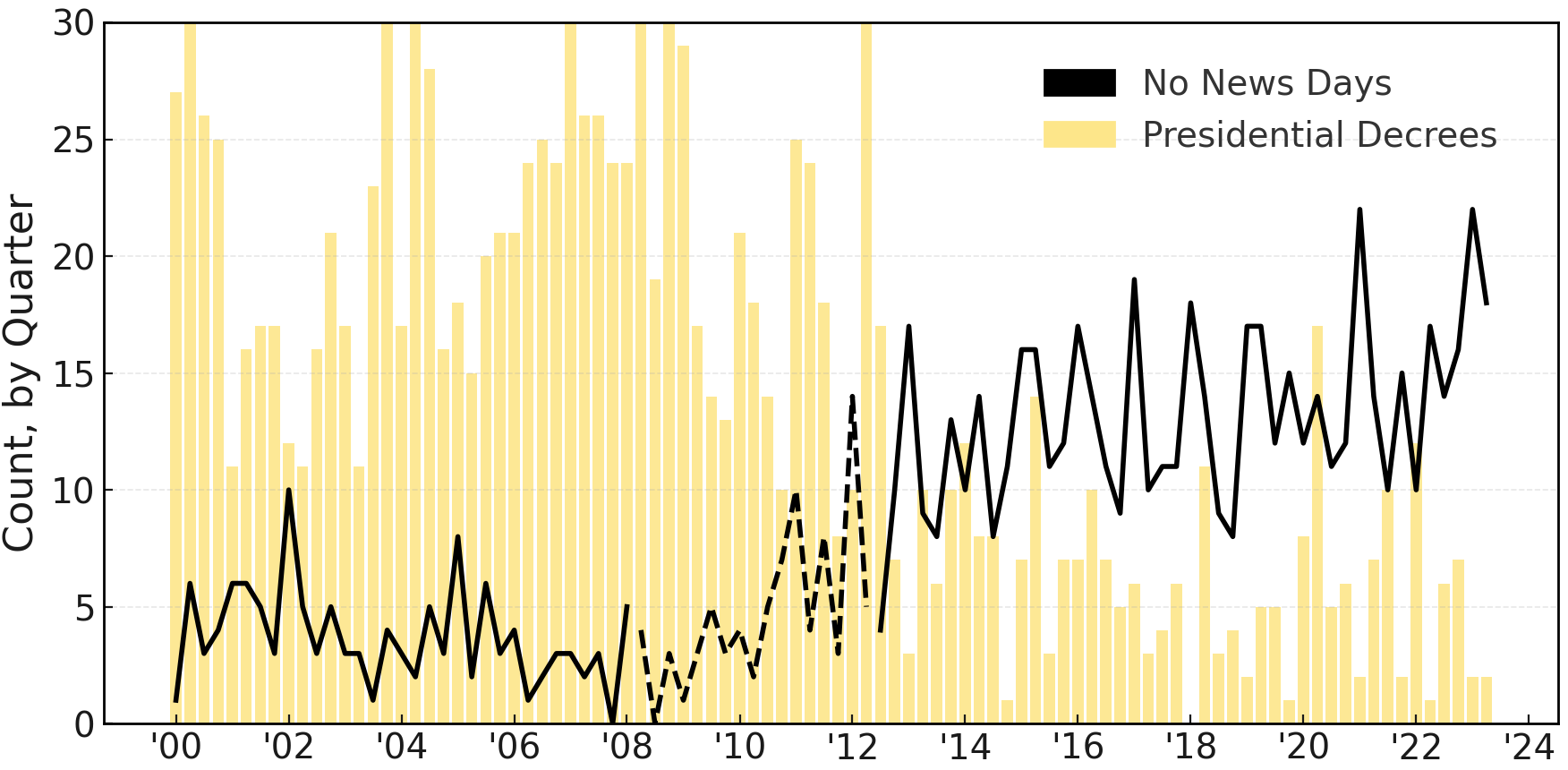
When and why do political leaders choose to disappear from the public eye? For democratic leaders, visibility is often constrained by institutional calendars, press obligations, and electoral incentives. For autocrats, however, the timing of public presence is more discretionary, and thus potentially strategic. In this project, I examine the logic of such disappearances through the case of Vladimir Putin. [click to expand]
Drawing on twenty-five years of daily data from the Kremlin’s official website, I analyze the logic of Putin’s media presence and absence. I identify systematic patterns in the days when he is missing from the public record and study what happens around stretches of prolonged absence. I juxtapose routine news silence with presidential decree signing, tracing how “appearance” via decrees relates to days without public events and how these dynamics evolve over time. By tracing an autocrat’s public visibility over a quarter-century, I shed light on the broader question of how leaders manage information control and maintain legitimacy.
God, Save the Tsar!
Cooptation of Religious Voters in an Electoral Autocracy (with Evgeny Sedashov, Daniil Romanov, and Vadim Devyatnikov)

Religious groups, with their moral authority, organizational resources, and mobilization capacity, often pose serious challenges to autocratic leaders, who respond through strategies such as repression, surveillance, and, notably, co-optation. Decades of anti-religious Soviet policy not only halted church construction, but actively pursued their destruction nationwide. The Soviet collapse triggered a wave of large-scale church construction — a development virtually unparalleled in modern history. [click to expand]
Drawing on a dataset of 31,000 churches, the paper shows that electoral support for the incumbent president significantly increased in areas with churches built between 2012–2018, with effect sizes ranging from 2 to 4.4 percentage points. It further demonstrates that this support stems from churchgoers’ fulfilled needs, not political indoctrination, economic spillovers, or social pressure.
Reversal of Misfortune:
Covid-19 in the Changing of Attitudes Toward Behavioral Disorders
(with Jessi Hanson-DeFusco and Dina Rosenberg)
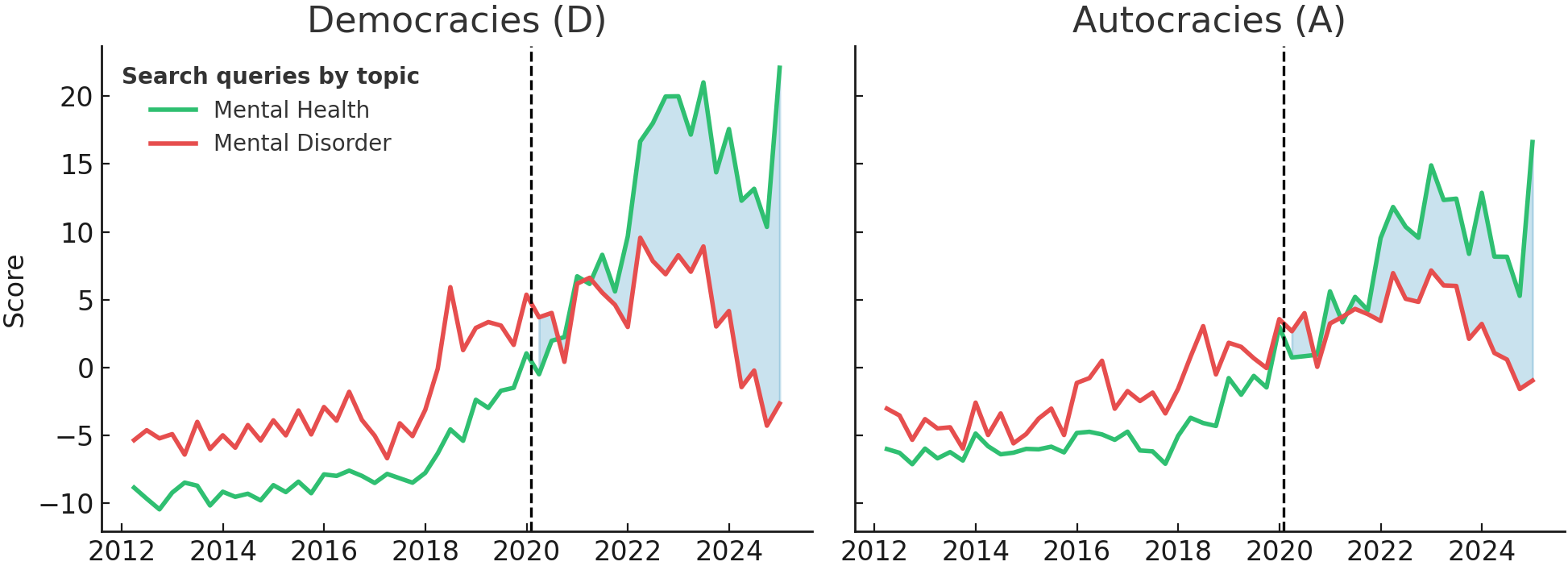
Do pandemics always harm mental health? This study documents a sharp and enduring shift in global priorities regarding mental health, as reflected in online search behavior before and after the Covid-19 pandemic. [click to expand]
Using longitudinal data from Google Trends across over 100 countries, we analyze how public interest moved away from severe psychiatric disorders toward general mental health and preventive wellbeing. We treat search behavior as a proxy for public attention and, by extension, underlying demand for specific types of mental health knowledge and services. We show that while interest in both severe disorders (e.g., obsessive-compulsive disorder and borderline personality disorder) and general mental health surged immediately after the pandemic’s onset, the trajectories subsequently diverged. Interest in severe disorders declined and plateaued. At the same time, interest in mental health and wellbeing continued to grow. This suggests a shift from reactive treatment-seeking to proactive self-regulation. The magnitude of this reversal, however, varies by regime type. In democracies the effect is pronounced, while in non-democracies it is less than half as large. To explain this asymmetry, we develop a theory in which authoritarian regimes deliberately maintain higher levels of social stress as a tool of political control. By keeping populations under persistent strain, autocrats reduce the scope for a full reorientation toward proactive wellbeing. The paper contributes to the emerging literature on the economics of public health by documenting an “attentional reversal.” In spirit, though not in mechanism, it resembles Acemoglu et al.’s institutional reversal in development economics.